There’s a specific kind of travel day that feels like a magic trick. You wake up somewhere new, grab a coffee that tastes nothing like home, wander into a neighborhood you can’t pronounce yet, and somehow—without a rigid itinerary—you end up eating the best thing you’ve had all year.
The myth is that these moments happen by accident. The truth is they usually happen because you’re prepared in the boring ways that don’t make it into the highlight reel.
Not “prepared” like you printed a spreadsheet and booked every meal three weeks out. Prepared like: you can pull up a map when you step out of the metro; you can translate a menu without awkwardly pointing at random; you can message a friend the name of that tiny stall you just discovered; you can reorder an ingredient allergy card; you can check if the spot that looks open is actually open; you can pull up your reservation QR code even when the restaurant Wi-Fi is doing the slow-motion death spiral.
For foodie flashpackers—travelers who want to move smart, eat well, and still keep things flexible—staying connected is a surprisingly core ingredient. Not because you need to live online, but because the less friction you have in the background, the more you can stay present in the foreground.
And when the foreground is a bowl of noodles, a paper plate of tacos, or a neighborhood bakery that smells like butter and caramel, presence is the whole point.
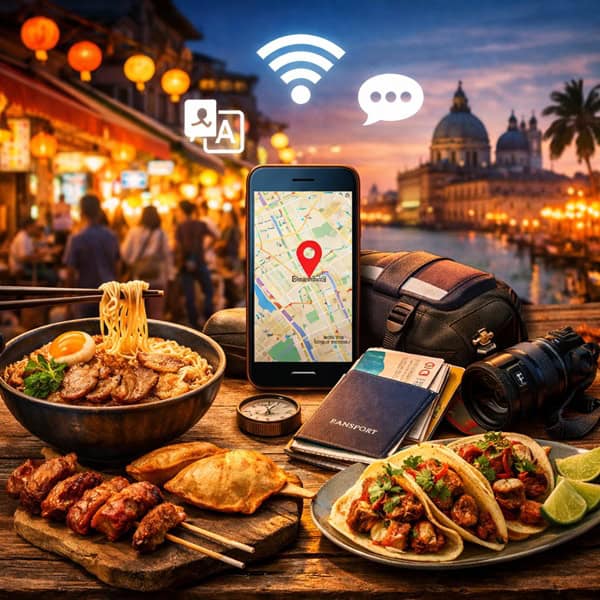
Why connectivity is more important on food trips than “regular” trips
Food-focused travel is a different beast. You’re not just going from attraction to attraction. You’re bouncing between markets, side streets, pop-up counters, late-night stalls, cafes you found in passing, and restaurants that might only exist if you show up at the right time on the right day.
The small frictions add up quickly:
- You find a place recommended by a local… but it’s pinned wrong, and the correct entrance is actually down an alley.
- You see a line and think “this is it,” but you’re not sure what people are lining up for.
- You try to pay and realize the vendor accepts a specific app, or exact change, or a QR payment method.
- You walk past a spot that looks closed, only to learn later they’re open—but the door is unmarked and you had to message them first.
- You’re deep into a neighborhood where every corner smells amazing, and now you have the best problem: which place do you choose?
A little bit of connectivity turns those moments from stressful to fun. It helps you improvise with confidence.
And the best part: you don’t need to be “always online.” You just need reliable access when it counts.
Keep it light, keep it flexible, keep it working
Flashpacking is essentially the sweet spot between backpacker freedom and adult-level efficiency. You’re not trying to “hack” travel by making it harder. You’re trying to remove the dumb obstacles so you can spend your time on the good stuff.
When the good stuff is food, a simple system works best:
- A short list of “must-eat” places (the ones you’d regret missing)
- A loose map of neighborhoods where you want to spend time
- A few saved searches for the type of food you’re craving (late-night noodles, best panaderías, local breakfast, etc.)
- A connectivity plan so your phone is a tool, not a liability
That last piece is the quiet hero. Because food plans are the most likely plans to change. And when plans change, you want to pivot fast.
eSIMs are the most painless upgrade for travel connectivity
If you’ve ever landed somewhere new and done the “airport SIM counter shuffle,” you know the vibe: fluorescent lighting, confusing plan names, a rushed employee swapping your physical SIM, and you silently hoping your messaging apps will still work afterward.
eSIMs (embedded SIMs) remove a lot of that friction. Instead of swapping a tiny plastic card, you activate a digital plan on your device. For many travelers, this ends up being the simplest way to arrive connected—especially when you care more about eating than troubleshooting.
If you want a quick, straightforward option, you can use something like the SIMOVO travel eSIM to get set up without the usual SIM-card dance.
The goal here isn’t to obsess over telecom details—it’s to protect your time. Because the minutes you spend hunting for connectivity are minutes you’re not hunting for food.
How staying connected makes you a better eater (seriously)
Here’s what changes when your phone works reliably on a food trip:
You stop “playing it safe” and start exploring
When you’re worried about getting lost, you choose the obvious places: tourist strips, well-marked restaurants, anything that feels guaranteed. That’s fine sometimes—but the best bites are often one or two turns away from obvious.
Reliable data lets you take the interesting turn and still feel anchored. You can wander deeper because you know you can always orient yourself.
You get better at following local recommendations
Locals rarely recommend places by full address. They recommend by landmark, vibe, or “it’s next to the pharmacy with the green sign.” Connectivity lets you triangulate quickly: map + a quick message + maybe a photo of the storefront, and you’re there.
You learn to read menus faster
Translation apps aren’t about being lazy—they’re about being brave. The less anxious you are about ordering wrong, the more likely you are to order the interesting thing.
Also: you can look up ingredients, regional dish names, or what that mysterious sauce actually is, without turning it into a half-hour research session.
You get smarter about timing
Food is timing. The best birria might sell out. The bakery might peak at 9 a.m. The night market might come alive at 8 p.m., not 6 p.m.
Being able to quickly check hours, message a spot, or confirm whether something is seasonal helps you plan lightly but effectively—without over-scheduling your day.
You can build a “crumb trail” of your best finds
Every traveler has eaten something incredible and then never found it again. Don’t let that happen.
When you’re connected, you can:
- pin the location properly,
- save a note with what you ordered,
- screenshot the menu item,
- and even record a short voice note like “get the spicy version next time.”
This is how you turn a good food trip into a repeatable playbook.
A simple connectivity routine that doesn’t hijack your trip
The biggest fear people have is that being connected means being distracted. It doesn’t have to.
Try this rhythm:
- Use your phone intentionally in short bursts.
Two minutes to orient. Two minutes to choose. Then put it away. - Save places as you go.
Pin the stall while you’re still standing there—future you will thank you. - Download what you can, keep data for what you can’t.
Offline maps and saved lists are great. But real-time decisions—like “where should we eat right now?”—are where data shines. - Keep one person in the group as the “navigator” when needed.
If you’re traveling with someone, alternate who checks the phone. It keeps the experience social and keeps you from both getting sucked in.
This keeps the phone in its proper role: a tool, not the main character.
Travel with more confidence, not more screen time!
Food travel is supposed to feel alive. It’s supposed to feel like you’re discovering something—not just consuming it.
Connectivity doesn’t replace discovery. It protects it.
Because when the basics are handled—maps, messaging, translation, access to reservations or payment info—you’re free to do what you came for:
- follow the scent of grilled meat down a side street,
- eat standing up because the food is too good to wait for a table,
- ask the vendor what they recommend and actually understand the answer,
- stumble into a market you didn’t plan for and stay longer than you expected.
That’s the heart of foodie flashpacking: structure where it matters, freedom everywhere else.
And if you build your trips with that in mind, you’ll find yourself having more of those “how did we end up here?” meals—the ones you talk about for years—without the chaos tax that usually comes with spontaneity.