Krakow tastes like history at every step – from simple street food bought on the corner to restaurants awarded with Michelin stars. A culinary walk through the city lets you try both the everyday flavours of locals and dishes once served to kings and artists. It’s a journey where simplicity meets elegance, and tradition blends with modern creativity.
Everyday Flavours of Krakow
The best way to start is with the most iconic and simple bites.
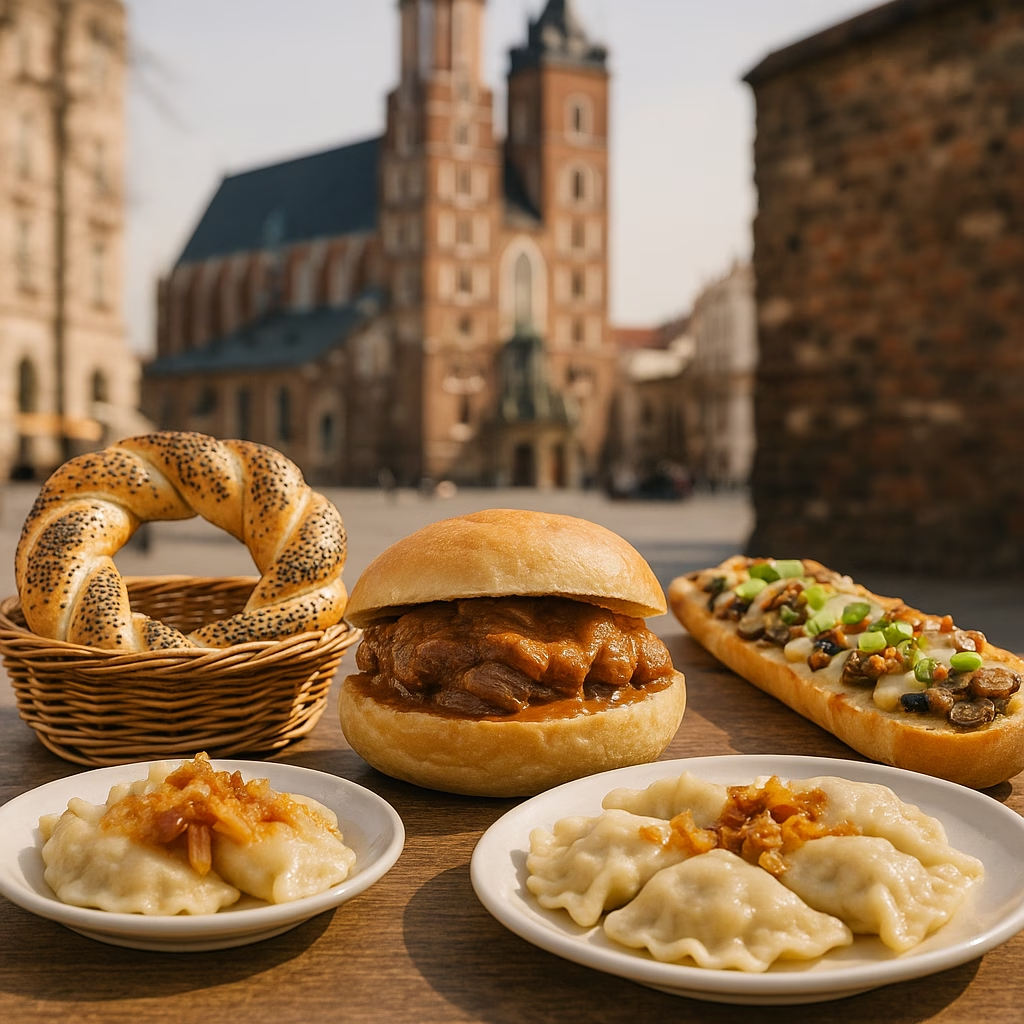
On every street corner, you’ll spot the Krakow obwarzanek – a chewy, braided bagel sprinkled with poppy seeds, sesame or salt, sold straight from wicker baskets. It has been a daily snack here for centuries.
Another must-try is the maczanka krakowska – tender pork in a rich sauce served inside a bun, often called the ancestor of the hamburger.
And when the night falls, head to Kazimierz and the famous zapiekanki from Plac Nowy’s “Okrąglak” – half a baguette covered with mushrooms, cheese, and your choice of toppings. They’ve been feeding Krakow’s nightlife for decades and proudly compete with döner kebabs as the city’s go-to late-night bite.
Traditional Polish Cuisine on the Plate
Although Krakow embraces international flavours, there are still places where you can savour the taste of old Poland.
At Pod Aniołami, located in a 13th-century townhouse on Grodzka Street, meats are roasted in a wood-fired oven and the stone interiors breathe medieval history.
Family-run Pod Baranem, near Wawel Castle, is beloved for hearty classics – pierogi, roast duck, or pork loin – served with elegance yet without pretension.
Meanwhile, Gościnna Chata on Sławkowska Street captures the mountain spirit with traditional dishes like potato pancakes with goulash, bigos, and rustic pierogi.
These restaurants let you taste Krakow the way it was before food trucks and hipster bistros.
Cafés and Restaurants with History
Some places in Krakow are more than restaurants – they’re time machines. For over a century, cafés and taverns have been meeting points for artists, writers, and politicians, shaping the cultural soul of the city.
The most famous is Wierzynek, which opened in the mid-19th century but recalls the legendary royal feast of 1364, when merchant Mikołaj Wierzynek hosted kings and nobles from across Europe. Today, dining here feels like stepping into Krakow’s regal past.
Just a few steps away, on Floriańska Street, is Jama Michalika, a café established in 1895. It was the cradle of the cabaret Zielony Balonik and the heart of Krakow’s bohemian life. The interior, filled with caricatures and paintings, still echoes with the spirit of Young Poland artists.
Another legendary address is the Piwnica pod Baranami, hidden in the Gothic cellars of the Palace under the Rams. From 1956, it was the stage of Piotr Skrzynecki’s famous cabaret, a place of satire, rebellion, and poetry. Today it’s a café and bar where you can sip wine and sense the ghosts of Krakow’s artistic past.
Right on the Main Square, inside the Cloth Hall, sits Café Noworolski – an elegant Viennese-style café that has been serving intellectuals and artists since 1910. Nearby, Hawełka became famous for its lavish open sandwiches and “breakfast snacks,” frequented by Sienkiewicz and Wyspiański.
And if you wander down Szpitalna Street, you’ll discover Poller’s inn – one of the city’s oldest taverns, dating back to 1834. Legend has it that an old raven lived there, greeting guests as if it were part of the staff. It’s in places like this that history in Krakow doesn’t sit in museums – it still lingers around the tables.
The Flavours of Kazimierz
Krakow has always been multicultural, and nowhere is it more visible than in Kazimierz. This district, once the heart of Jewish life, is now full of restaurants where Polish and Jewish traditions intertwine.
At NOAH, you’ll taste modern interpretations of Jewish and Polish dishes. Hamsa serves colourful mezze plates and aromatic spices that feel like a Middle Eastern market. Meanwhile, Hevre, housed in a former synagogue, blends raw historic walls with a trendy, contemporary kitchen.
Walking through Kazimierz is like tasting a living mosaic – each dish a reminder that without this quarter, Krakow’s culinary portrait would be incomplete.
Dining with a View
Sometimes food tastes even better with a view, and Krakow has some unforgettable dining panoramas.
The most famous is U Ziyada, in the romantic castle of Przegorzały. The restaurant offers sweeping views over Krakow and even the Tatra Mountains on clear days. Yet the castle itself hides a darker past – it was built during World War II on the order of Nazi governor Hans Frank. Today, however, it’s a place of peace, where people come to celebrate life.
Another gem is Vidok – Café Manggha, just across the river from Wawel. With its minimalist design, Japanese-Polish inspired menu, and the castle as your backdrop, it’s one of the city’s most atmospheric spots.
If you prefer a rooftop setting, head to Café Oranżeria on top of the Hotel Kossak. The panorama here stretches over the Vistula River, Wawel, and the boulevards – perfect for a romantic dinner or evening cocktail.
A little further from the city centre lies the Benedictine Abbey in Tyniec. Its café terrace offers serene views of the Vistula and monastic walls. You can also buy products made by the monks themselves – honey, liqueurs, jams, and bread – a blend of spiritual heritage and regional flavours.
Unusual Culinary Experiences
Krakow is full of surprises for food lovers.
In the Wilczy Dół Tavern, inspired by the world of “The Witcher,” you’ll pay with dukats, be served by elves and sorceresses, and sip mysterious elixirs. It’s not traditional Krakow cuisine, but it’s certainly an adventure to remember.
Even more extraordinary awaits underground. On the Salt mines tour Krakow, you’ll discover that the Wieliczka Salt Mine isn’t just about stunning chambers and chapels – you can also sit down to a meal in the salt-carved halls, 135 metres below ground. Dining here is one of the most unique culinary experiences in Poland.
From Street Food to Michelin
At the peak of this journey stands Bottiglieria 1881, the first restaurant in Poland to receive two Michelin stars. It proves that ingredients from Małopolska can become part of world-class culinary art.
For a more relaxed take on the same chef’s vision, try Bufet – a modern bistro where fine-dining precision meets a casual, welcoming atmosphere.
International Flavours
Krakow is also a cosmopolitan city. Beyond Polish and Jewish dishes, you’ll find Italian excellence at Fiorentina or Nolio, French charm at Zazie Bistro, refined fusion at Albertina or Karakter, and fresh sushi at places like Hana or Nami. And for a quick southern-style snack, locals swear by the focaccia at Fokarnia – a simple idea that became a neighbourhood favourite.
Culinary Trips Beyond Krakow
If you’re ready to leave the city behind, Małopolska has even more to offer.
Just 20 km away lies Dwór Sieraków, a historic manor surrounded by parkland, serving elegant Polish dishes with a modern twist. Its pride is one of the best-stocked wine cellars in the region, making it a refined countryside escape.
For something simpler, visit the Ojcowski National Park. At the foot of limestone cliffs and castle ruins, a small wooden hut by the pond serves freshly smoked or grilled Ojców trout – caught on site and prepared straight away. It’s proof that the simplest meals, eaten in nature, can be unforgettable.
Or head further south to Podhale, the land of the Tatra Mountains. Here, highland taverns serve oscypek with cranberry, kwaśnica (sauerkraut soup with ribs), and moskole, potato cakes baked on a griddle. It’s food best enjoyed with the sound of traditional góralska music and the breathtaking backdrop of the Tatras.
Krakow is a city where food itself becomes a journey – from a warm obwarzanek bought on the street, to a royal feast at Wierzynek, and fine dining at Bottiglieria 1881. And when you find yourself by a pond in Ojców with a smoked trout, on a monastery terrace in Tyniec with monk-made honey, or in a mountain inn with oscypek and live highlander music, you’ll understand that Małopolska tastes like diversity. A culinary story every traveller should experience on their own plate.