Peru’s Cuisine – A Regional and Cultural Guide for Food-Curious Travelers
Peru grows more than 3,000 native potato varieties in the Andes, and that fact has little to do with Lima’s tasting menus. It explains why Peruvian food is truly unlike anything else in the world. Most coverage of the cuisine starts in the capital and works outward, treating fine dining as the source of variety instead of the outcome of rural, indigenous, and immigrant food traditions that have evolved for centuries. Travelers who understand the real structure behind that diversity, the three major regional food systems, the immigration layers, and the ancient highland techniques, tend to eat far better across a full trip than those working from a checklist of famous dishes. This guide gives food-curious travelers the geographic and cultural context to read Peruvian cuisine on its own terms before ordering a single plate.

The Three Food Worlds That Make Peruvian Cuisine Genuinely Diverse
Peru’s food diversity isn’t a slogan. It comes directly from three ecologically distinct regions, each a separate food system with its own ingredients, methods, and cultural logic. Knowing that structure is what separates a traveler who eats well from one who finds the same few dishes everywhere.
Why Geography Is the Starting Point
The coast, the Andes, and the Amazon aren’t interchangeable backdrops. Each produces its own proteins, starches, cooking heat sources, and preservation needs. Those differences appear on the plate in ways anyone can taste and see.
Coastal cooking depends on the cold Humboldt Current running up Peru’s Pacific shore, producing some of the most nutrient-dense fish and shellfish on the planet. Andean cooking is defined by altitude, frost, and a biodiversity of tubers and grains found nowhere else. Amazonian food builds on river systems, tropical forests, and ingredients unique to that region. These are not variations on one cuisine but three different food logics that happen to share a border.
What Travelers Actually Encounter Across Regions
A trip from Lima to Cusco to Iquitos isn’t one cuisine getting louder. It’s three separate food realities in succession, and recognizing that is the practical payoff of understanding Peru’s geography.
In Lima, plates reflect the Pacific and the city’s portside immigration history. In Cusco, they reflect altitude farming, grain culture, and centuries of indigenous technique. In Iquitos, the cooking reflects the Amazon basin, river fish, tropical fruits, and leaf-wrapped dishes with no counterpart in the highlands or on the coast. A traveler expecting slight variations on what they ate before will miss what makes each region worth exploring.
The Andean Highlands: Where Peruvian Food Diversity Is Rooted
The highlands are the source of ingredients that now define Peruvian food worldwide: thousands of native potato varieties, quinoa, kiwicha, kañiwa, and chili peppers that form the flavor base across all regions. Lima’s high-end menus may showcase them, but the biodiversity comes from the sierra, not the capital.
The International Potato Center in Lima tracks more than 3,000 native varieties grown across Andean communities, many sold only in local markets. Their colors range from deep purple to bright yellow to mottled red, and each has its own starch and flavor profile. When Central, ranked the world’s best restaurant in 2023, builds a tasting menu around Peru’s ecosystems, the highland section isn’t a creative flourish, it’s an acknowledgment that the Andes are the pantry.
Pachamanca and the Earth-Oven Tradition
Pachamanca isn’t a festival gimmick. It’s a pre-Columbian method where meat, potatoes, and vegetables cook slowly in a pit lined with hot stones, one of the oldest continuous cooking techniques in the Americas. Seeing it in the Sacred Valley or other highland areas means witnessing a practice that shaped the cuisine’s relationship to slow heat and layered flavor.
The preparation takes hours. Stones are heated in a fire, arranged in a pit, layered with marinated meat, potatoes, corn, and beans, then sealed with earth to cook in residual heat. The result is smoky, deeply savory, and impossible to replicate with an oven or stove. Pachamanca now appears in food-based tourism around the Sacred Valley, so travelers can experience it without attending a family feast, though community versions are often the most instructive.
Chuño and the Science of Andean Preservation
Chuño, the freeze-dried potato made by Andean communities, is one of history’s most advanced pre-industrial preservation methods. Potatoes are exposed to overnight frost, then pressed over several days to remove moisture, creating a shelf-stable ingredient that has fed the Andes for centuries and still shows up in soups and stews.
The process requires high-altitude nights where temperatures drop below freezing year-round. That climate precision makes chuño a true highland product with no real substitute elsewhere. On menus, it appears in hearty soups or braised dishes, adding a dense, earthy texture unlike any fresh potato. Travelers who don’t know its background might find it puzzling, but with context, it’s what it has always been: a centuries-old fix for feeding communities through lean seasons.
Andean Grains Beyond Quinoa
Kiwicha and kañiwa are older than quinoa’s global fame and remain staples in highland diets. They show up in soups, porridges, and snacks across Andean cities, and their appearance on a menu signals a kitchen drawing from indigenous pantry logic rather than tourist shortcuts.
Kiwicha, or amaranth, has a faintly sweet, nutty flavor and fine grain that suits both sweet and savory dishes. Kañiwa is smaller, more bitter, and earthier, common around Puno near Lake Titicaca. Nutritional studies of ancient grains confirm their high-quality protein and micronutrients that kept Andean populations healthy for millennia. Travelers exploring highland markets will find them in everyday forms that restaurant menus rarely capture.
The Coast and the Ceviche Tradition
Coastal Peruvian cuisine is built on the cold, nutrient-heavy waters of the Humboldt Current, yielding an incredible range of fish and shellfish. Ceviche might be its best-known dish, but the coast also gives us tiradito, causa, arroz con mariscos, and leche de tigre, each an expression of technique applied to the same oceanic abundance. Ají amarillo, called the soul of Peruvian cooking by PROMPERÚ, ties them together.
Causa is a layered potato terrine made from yellow potato mashed with ají amarillo and lime, filled with avocado, tuna, or chicken, and served cold. Arroz con mariscos is rice cooked with seafood in a sauce of ají amarillo and cilantro, more like risotto than paella. Each uses the same basic ingredients but through different methods and textures. The point is simple: the coast isn’t one dish. It’s a system.
How Peruvian Ceviche Actually Works

Peruvian ceviche isn’t fish marinated for hours. The citrus cure lasts less than ten minutes, giving the fish a firm but raw texture. The leche de tigre left in the bowl is part of the dish. The difference from Mexican or other Latin American ceviches is technical, not just regional, and understanding it changes how travelers eat.
A typical ceviche has fresh white fish, sliced fine, dressed with lime juice, ají amarillo, red onion, and salt, served with cancha (toasted corn) and sweet potato on the side. The leftover leche de tigre, a mix of citrus and fish juices, is often drunk at the end or served separately as a light starter. Skipping it means leaving behind what many Peruvians consider the best part. Ceviche is a lunch dish across Peru, and eating it for dinner, especially at tourist restaurants, usually means the fish has been sitting since midday.
Tiradito and the Nikkei Influence on Coastal Cooking
Tiradito looks like ceviche but is sliced sashimi-style and made without onion, a clear trace of Nikkei technique meeting coastal ingredients. It’s one of the best examples of immigration visible in a single dish, appearing on menus all over Lima as proof of fusion that started in working kitchens, not fine-dining labs.
The sauce varies by chef but often includes ají amarillo, leche de tigre, and sometimes sesame or citrus that feels distinctly Japanese. The missing onion isn’t a matter of taste; it changes texture and balance, letting the fish and sauce lead the flavor. Ordering both ceviche and tiradito in one meal is a direct way to taste how Nikkei technique shaped Peruvian coastal cooking.
The Amazon – The Region Peruvian Food Coverage Consistently Skips
Amazonian cuisine rarely appears in top food coverage, even though the selva covers about 60 percent of Peru and offers a food culture built on ingredients found nowhere else. Juane, rice and chicken steamed in bijao leaves, is its most recognizable dish. Pescado a la hoja, river fish cooked in leaf wrap, and tacacho con cecina, mashed plantain with smoked pork, are everyday foods in Iquitos and Tarapoto. Local fruits like camu camu, cocona, and aguaje appear in juices, sauces, and desserts unseen elsewhere in Peru.
The bijao leaf does more than wrap, it imparts a faint herbal taste and locks in moisture, giving food a unique texture. Paiche, one of the world’s largest freshwater fish native to the Amazon, appears grilled, fried, or in stews across Iquitos. Its mild, firm flesh absorbs surrounding flavors easily, making it ideal for the region’s bold sauces. Travelers who reach Iquitos or Tarapoto without knowing what to ask for are missing the most original ingredients in the country.
Why Lomo Saltado Has Soy Sauce in It
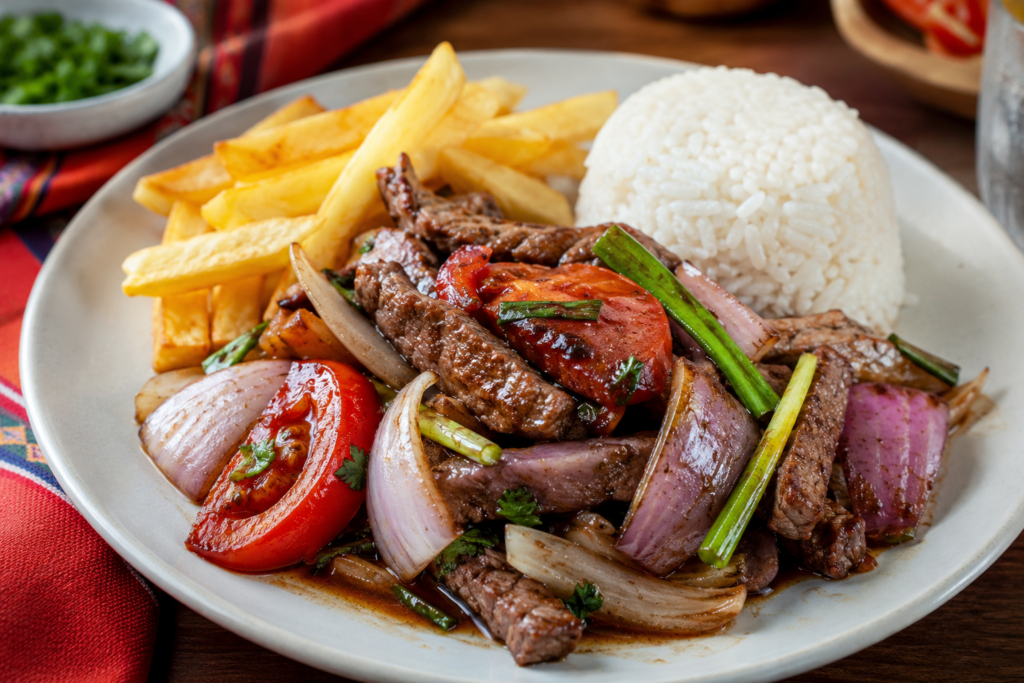
Soy sauce, ginger, and wok cooking in a dish built on Andean beef and potatoes aren’t modern fusion, they’re the legacy of Chinese indentured laborers who arrived in the mid-19th century. Their techniques and pantry met local ingredients, creating chifa, the Peruvian-Chinese tradition now so commonplace that arroz chaufa and wantán frito appear on menus from Lima to small Andean towns.
African influence, brought through the slave trade, shaped coastal criollo dishes in equally visible ways. Tacu tacu, a fried cake of leftover rice and beans, and anticuchos, grilled beef heart skewers, both trace to Afro-Peruvian traditions. Spanish colonization added olive oil, garlic, and dairy to a cuisine that hadn’t known them before the 16th century. Each immigration wave left visible marks on dishes and methods, not as history notes but as living practice.
Chifa – From Immigrant Survival to National Staple
Chifa restaurants began as neighborhood spots serving Chinese-Peruvian communities. Today they’re one of Peru’s most common restaurant types, and their high-heat stir-frying and soy-based sauces have become so embedded that most Peruvians no longer see them as foreign. Scholars note that chifa evolved from immigrant survival food into a national symbol.
Arroz chaufa, fried rice with egg, soy sauce, green onion, and protein, is eaten by everyone, everywhere. Tallarín saltado, stir-fried noodles with meat and vegetables, comfortably appears on the same menu as ceviche and lomo saltado. The wok arrived with Chinese laborers in the 1850s and never left.
Nikkei – Japanese Precision Applied to Peruvian Ingredients
Japanese migration starting in 1899 created a distinct style blending Japanese technique, raw fish work, precise knife skills, minimalist seasoning, with Peruvian ingredients like ají amarillo, leche de tigre, and native corn. Nikkei is now one of Peru’s most recognized exports, with restaurants from Miami to London referencing it directly. Knowing its roots explains why Maido’s food feels both Japanese and distinctly Peruvian.
Nikkei’s fusion isn’t aesthetic. It’s practical. Japanese immigrants had access to Peruvian fish and peppers, not the foods of home. The mix that emerged became neither fully Japanese nor traditionally Peruvian but something unique to that meeting of cultures, a genuine tradition born from necessity.
The Practical Structure of Eating in Peru
Most guides list what to eat but not when or how meals fit into the day. Lunch is Peru’s main meal, eaten from noon to 3 p.m. and often served in multiple courses. Breakfast is light; dinner lighter still, often just soup or a small plate.
This rhythm shapes availability. Cevicherías serve lunch only, closing by late afternoon. Markets are busiest in the morning. The best stews, soups, and braises are cooked early and gone by 2 p.m. Travelers on a dinner-focused schedule will miss the best food.
What a Menú del Día Actually Is
The menú del día is a fixed-price lunch served everywhere in Peru, usually soup, a main with rice and salad, dessert, and a drink, for S/10, S/20 at local spots. It’s the surest way to eat well and cheaply, and it’s how most Peruvians eat lunch during the workday. Travelers who skip it for à la carte menus pay more for less and miss a window into real local cooking.
Menus change daily depending on what’s fresh, so they reflect the true pantry better than fixed menus. In Cusco, soup might be chupe de quinua. In Arequipa, chupe de camarones. In Iquitos, paiche or river shrimp could appear as the main. Reading a menú del día’s regional character is one of the clearest ways to see where the kitchen sources its food.
Ají Peppers and the Flavor Infrastructure of Peruvian Cuisine
Ají amarillo, ají panca, and rocoto are not interchangeable. Each offers a distinct flavor, heat, and role. Ají amarillo is fruity and medium-hot, used in ceviches, sauces, and stews. Ají panca is smoky and mild, perfect for marinades and braises. Rocoto is fiery and sweet, starring in rocoto relleno and table sauces. Peru is a leading producer of these peppers, and their use says more about regional identity than almost any ingredient.
Ají amarillo appears in more Peruvian dishes than anything else, which makes PROMPERÚ’s label of it as the soul of the cuisine accurate. It’s the base of huancaína sauce, the heat in ceviche, the color in ají de gallina, and the quiet note in countless recipes. Travelers who learn its fruity, balanced heat will recognize it everywhere.
Rocoto deserves a mention for its surprising intensity. Many mistake it for a bell pepper, then discover its heat. Rocoto relleno, an Arequipa specialty, stuffs the pepper with beef and cheese, then bakes it whole. The result is sweet, savory, and truly spicy in a way ají amarillo isn’t. Arequipa’s rocoto-driven culture differs so much from Lima’s that the two cities feel like separate eating worlds.
Vegetarian and Vegan Eating in Traditional Peruvian Cooking
Vegetarian and vegan travelers often ask what’s possible in traditional cooking. The reality: Peruvian food is protein-forward, but the Andean pantry built on potatoes, corn, quinoa, oca, and olluco offers many dishes that were plant-based long before modern labels. Causa, papa a la huancaína, and chupe de quinua are all naturally vegetarian. Highland markets show this best, where cooks sell dishes that have never included meat and aren’t substitutes for anything.
A caution: chicken stock sneaks into many soups, and lard is used in some breads and fried foods. Travelers with strict diets should ask directly. In Lima, fine-dining chefs have moved toward plant-forward menus, offering vegetable causas and vegan ceviche, but that’s an urban trend, not traditional practice. The most authentic plant-based eating happens in the highlands, not in restaurants catering to global trends.
What Changes When You Know This
Peru’s culinary reputation wasn’t built in a Lima kitchen. It was built across three thousand meters of altitude, in highland towns still cultivating ancient potatoes, in Amazonian river cities where the fish don’t have Spanish names, and in immigrant neighborhoods where a wok met a bag of ají amarillo. Travelers who arrive knowing only the ceviche shorthand will eat well. Those who understand the structure behind it will eat better, at the right hours, in the right places, at a menú del día that says more about location than any review ever could. The food is already waiting. The difference is knowing what you’re looking at when it arrives.
FAQs about Peruvian cuisine
What are the three main regional food traditions in Peru?
Peru’s cuisine splits into three systems: coastal cooking built around fish and seafood, Andean cooking centered on potatoes, quinoa, and earth-oven methods, and Amazonian cooking featuring jungle proteins and fruits. Each has its own ingredients, preservation habits, and meal rhythm, so traveling from Lima to Cusco to Iquitos means tasting three distinct food worlds.
Why does lomo saltado have soy sauce in it?
Lomo saltado’s soy sauce and wok cooking come from Chinese laborers who arrived in the 1800s, bringing their cooking skills to local ingredients. This chifa fusion became so rooted in Peruvian culture that few see it as foreign, though it’s a clear trace of immigration history on the plate.
What is a menu del dia and why should I eat it?
A menú del día is a fixed-price lunch (about S/10, S/20) served between noon and 3 p.m., typically with a starter, main, dessert, and drink. It’s the most authentic, affordable way to experience what locals actually eat, since it uses seasonal ingredients and generous portions.
What’s the difference between ají amarillo, ají panca, and rocoto?
These peppers each bring different flavors. Ají amarillo is mild and fruity, used in creamy stews and ceviche sauces. Ají panca is dark, smoky, and gentle, found in adobos and slow-cooked dishes. Rocoto is hot and fruity, often stuffed whole in rocoto relleno. Their use signals regional cooking identity more reliably than almost anything else.
What Amazonian dishes should I know about?
Juane (rice and chicken steamed in leaves), pescado a la hoja (leaf-wrapped fish), and tacacho con cecina (mashed plantain with smoked pork) are daily Amazon staples from Iquitos and Tarapoto, representing 60 percent of Peru’s territory yet rarely covered by media. The region’s fruits, camu camu, cocona, aguaje, don’t exist elsewhere, so knowing the dishes keeps you from eating blind.
Is Peruvian food vegetarian-friendly?
Yes, though most guides skip this point. Causa can be filled with avocado or cheese, papa a la huancaína works with vegetables, and many Andean soups rely on quinoa and native tubers. Many traditional recipes use meat stock or fish sauce, so ask before ordering instead of assuming menus clarify it.
What’s the difference between Nikkei and chifa cuisine?
Chifa came from 19th-century Chinese migration, producing dishes like arroz chaufa (fried rice) and tallarín saltado (stir-fried noodles). Nikkei came from Japanese migration in the early 20th century, applying raw fish precision to Peruvian flavors like ají amarillo and leche de tigre. Both are now seen as part of Peruvian identity, not imports.
Why are Andean potatoes and grains so important to Peruvian cuisine?
Peru is the birthplace of the potato, with over 3,000 native varieties still grown in the Andes, each shaping dishes like causa, papa a la huancaína, and carapulcra. Quinoa and kiwicha have been cultivated for thousands of years and remain central to soups and other traditional foods. Peru’s food diversity comes from the highlands, not from Lima’s fine-dining scene.
How do Peruvians structure their eating day?
Breakfast is light, bread, coffee, maybe a pastry. Lunch is the main meal, often a two- or three-course menú del día. Dinner is lighter, maybe soup or a sandwich. Knowing this helps travelers plan, since most local venues close after lunch.
What cooking techniques like pachamanca and chuño are foundational to Peruvian food?
Pachamanca is a highland earth-oven method where meat, potatoes, and vegetables cook together in a pit with hot stones, still used today for celebrations and daily meals. Chuño is freeze-dried potato made by mountain frost and sun, a preservation method that shaped Andean food for centuries and still appears in soups and stews.